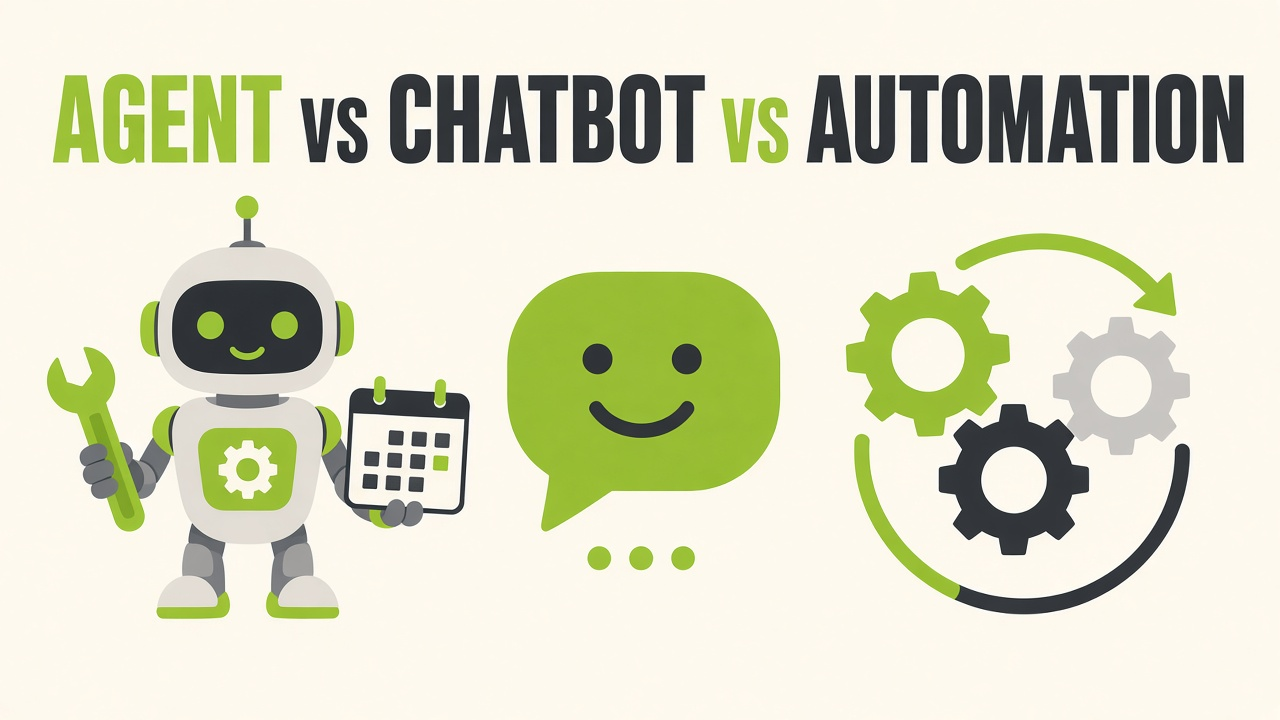
People often tell me they want an AI agent. When we talk it through, quite often what they actually need is a simple automation that sends an email when a form comes in. That's not a bad thing. It's cheaper, it breaks less and it can be live in days.
The words get mixed up a lot, partly because every software company now calls its product an agent. So here's how I tell the three apart, what each is good for, and how I'd decide for a small business.
Simple automation: the same steps, every time
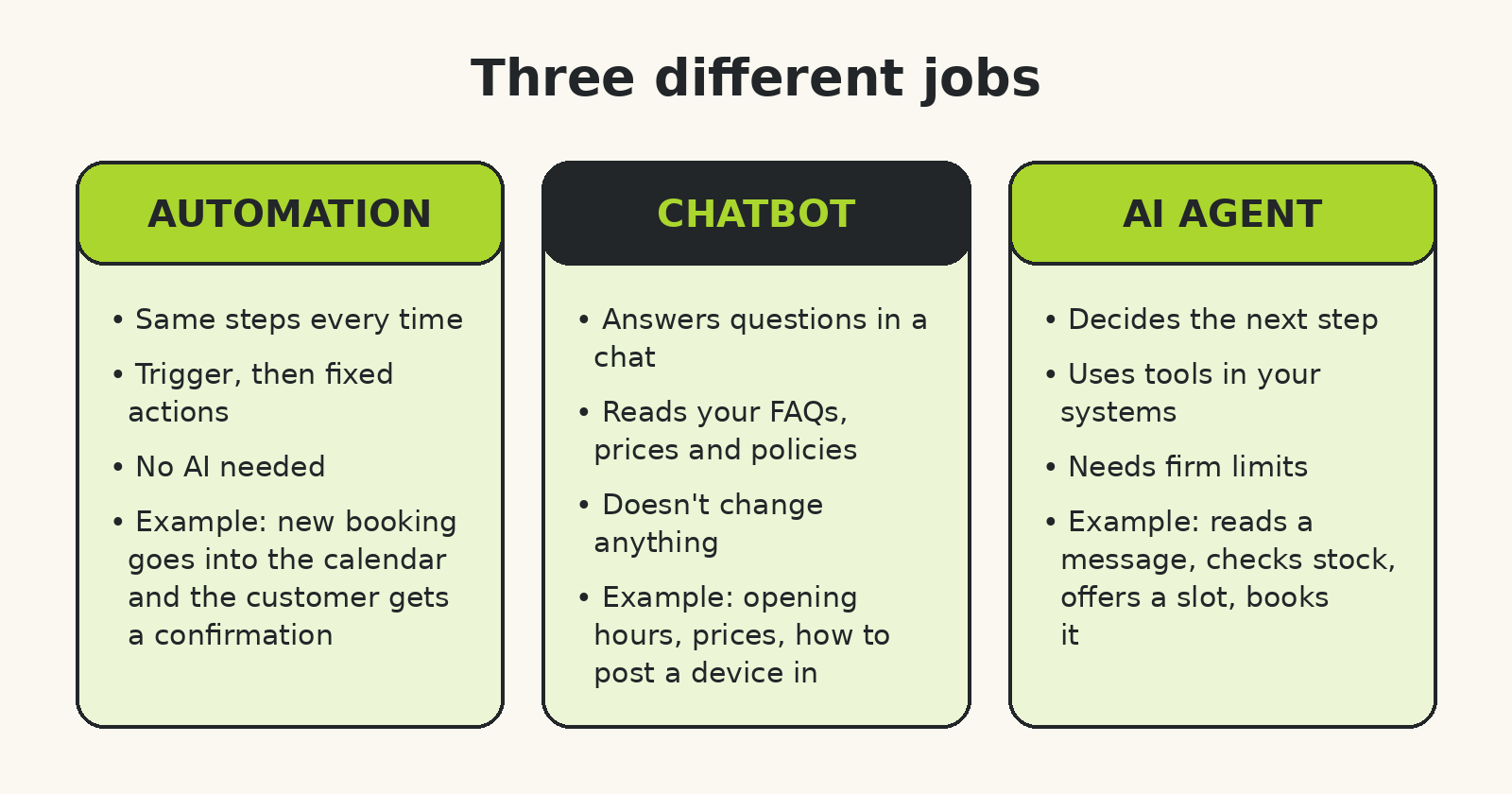
An automation is a fixed recipe. Something happens, then a set list of steps runs. A customer books online, so the booking goes into the calendar, a confirmation email goes out and a row is added to your sheet. No judgement, no AI, no surprises.
This is what tools like n8n, Zapier and Make are built for, and plain code does it just as well. I compare those tools in a separate post.
It's the boring option and I mean that as praise. When it fails, it fails in a way you can see and fix. You can read the steps and know exactly what it'll do tomorrow.
The limit is that it can't cope with anything it wasn't told about. A customer writes "can I move Thursday to next week, and also how much for a screen?" and a fixed recipe has no idea what to do with that.
Chatbot: answers questions
A chatbot sits in a chat window, on your website, WhatsApp or Instagram, and answers questions. A modern one uses a language model and reads from your own content: prices, opening hours, policies, FAQs. It talks. It doesn't do.
For a lot of small businesses that's genuinely useful. If the same twenty questions come in every day, a chatbot can answer them at 2 am while you sleep.
The risk is that it answers confidently when it's wrong. The best known example is Moffatt v. Air Canada. The airline's website chatbot told a customer they could claim a bereavement fare after travelling, which wasn't the airline's policy. In February 2024 a Canadian tribunal held Air Canada responsible for what its chatbot said and rejected the idea that the bot was somehow separate from the company.
That case changed how I build chatbots. Prices and policies come from your real system, not from the model's memory, and if the bot doesn't know, it says so and passes the chat to a person. I wrote more about that in why the system of record should have the final say.
AI agent: decides and acts
An agent goes a step further. It reads the situation, decides what to do next, and uses tools to do it. Check stock. Look at the calendar. Create the booking. Update the CRM. Then it looks at the result and decides again.
Anthropic's engineering team has a clear way of putting the difference in Building effective agents. Workflows are systems where the model and tools follow predefined code paths. Agents are systems where the model directs its own process and tool use. They also say something I agree with completely: start with the simplest solution possible, and only add complexity when it's needed. Sometimes that means not building an agent at all.
Agents are brilliant for messy, open-ended work. A message that mixes a reschedule, a price question and a complaint. A document that needs reading, checking and filing in the right place. That's the kind of thing I build, and you can try some of them on my live demos.
But an agent that can act can also act wrongly. Anthropic's same post warns that autonomy means higher costs and the potential for compounding errors. So I never let an agent touch payments, refunds or deletions without a person approving it, and I keep the limits outside the agent where it can't switch them off. More on that in put guardrails where agents can't reach and stop giving AI agents your passwords.
Side by side
| Simple automation | Chatbot | AI agent | |
|---|---|---|---|
| What it does | Runs fixed steps when something happens | Answers questions in a chat | Decides the next step and takes actions |
| Uses AI | No, or only for one small step | Yes | Yes |
| Changes your data | Yes, in a fixed way | Usually not | Yes, through tools you allow |
| Effort to build | Lowest | Medium | Highest |
| Running cost | Low and predictable | Depends on chat volume and model | Higher, and varies with each task |
| Main risk | Breaks quietly when an app changes | Gives a wrong answer with confidence | Takes a wrong action |
| How I'd reduce it | Error alerts and a weekly check | Answers from your real data, hand-off to a person | Approvals for risky actions, limits outside the agent, logs |
| Good first project | Bookings into calendar, invoices into accounts | FAQs on WhatsApp or your website | Triage and booking across systems |
I've kept money out of the table on purpose. Costs depend on your volume, your tools and how much of your system it needs to touch, and I'd rather price a real job than guess.
Which should you pick?
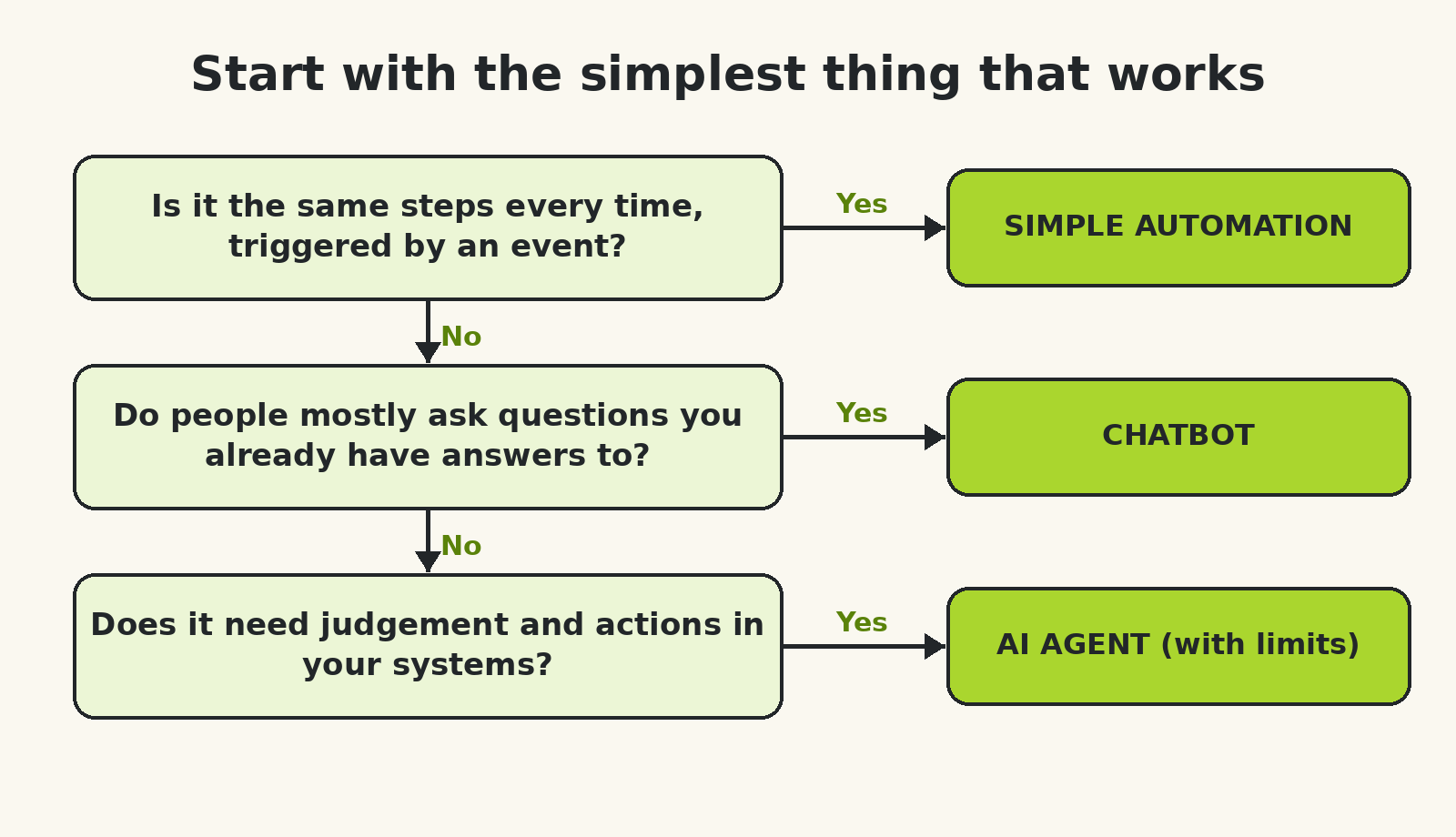
Write down the job in one sentence first. Then ask three questions.
Is it the same steps every time, triggered by something? Automate it. Don't add AI just because you can.
Is it mostly people asking things you already have answers to? A chatbot, fed from your real prices and policies, with an easy way to reach a person.
Does it need someone to read, think and then do something in your systems? That's where an agent earns its cost. Start it small, on one job, with a person approving anything risky.
You'll often end up with a mix. In practice a good agent sits on top of plain automations. The agent makes the judgement call and the boring, tested automation does the actual work. A small decision step can also sit in the middle, which I covered in not every step needs an agent.
FAQ
Can I start with a chatbot and turn it into an agent later? Yes, and I'd often suggest it. You learn what customers really ask before you let anything take actions. Just build it on your real data from day one so you aren't starting again.
Will an AI agent replace my staff? Not in the way people fear. What I see it replace is the copying, sorting and chasing. Someone still needs to handle the difficult customer and approve the refund.
Is a chatbot safe to put on WhatsApp? It can be, if it only answers from approved content and hands over to a person when it's unsure. The Air Canada case is a good reminder that you're responsible for what it says.
Do I need a big budget for an agent? Not necessarily. A narrow agent on one job is far cheaper than a broad one. The cost goes up with every system it touches and every action it's allowed to take.
Let's work out which one fits
If you've got a job in mind and you're not sure which of the three it needs, send it to me. I'll tell you honestly, even if the answer is a ten-step automation and no AI at all. Have a look at my services, then book a call or get in touch.
 Mubashir HussainForward deployed engineer